
CATAN The Settlers of Catan, Die Siedler von Catan, Les Colons de Catane
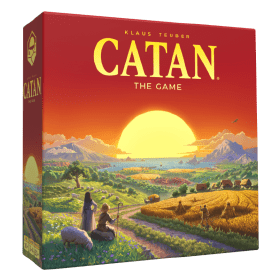 Først udgivet i Tyskland i 1995 som Die Siedler von CATAN, derefter på engelsk som The Settlers of CATAN i 1996, Settlers fejrer sit 25-års jubilæum i 2020.
For at begynde spillet bygger du spillepladen ved hjælp af sekskantede terrænfelter. Settler er født - en smuk ø med bjerge, græsgange, bakker, marker og skove, omgivet af havet.
Hver af jer sætter to små hytter på felter, hvor tre brikker mødes. De er jeres udgangspunkt.
Og sådan begynder det. Startspilleren slår med to terninger. "11!" Hver terrænfelt er markeret med et nummer. Hver spiller, der ejer en hytte, der støder op til en terrænfelt markeret med det slåede nummer, modtager en ressource produceret af det pågældende terræn. Bakker producerer mursten, skove producerer træ, bjerge producerer malm, marker producerer korn, og græsgange producerer får.
Du bruger disse ressourcer til at udvide Settlers: du bygger veje og nye hytte eller opgraderer dine eksisterende hytter til byer. For eksempel koster en vej 1 mursten og 1 træ. Hvis du ikke har de nødvendige ressourcer, kan du få dem ved at handle med dine modstandere.
Hver hytte er værd 1 point og hver by er værd 2 point. Hvis du er klog og har heldet med dig, kan du blive den første, der når 10 point, og derved vinder spillet!
Antal spillere: 3 - 4
Spillængde: 35 mn
Kompleksitet: 2 / 5
Spil CATAN og 1408 andre spil online.
Ingen download nødvendig - spil direkte fra din webbrowser.
Med dine venner og tusindvis af spillere fra hele verden.
Gratis.


Spil CATAN og 1408 andre spil online.
Ingen download nødvendig - spil direkte fra din webbrowser.
Med dine venner og tusindvis af spillere fra hele verden.
Gratis.
Spilsammenfatning
Objective
Get resources to buy various buildings and development cards, and try to be the first player to reach 10 points (or 13 in case of City & Knights)
Setup
- The board consists of hills (brick), forest (lumber), mountains (ore), fields (grain), pasture (wool) and a desert (nothing) at random places.
- Each terrain except the desert has a number of 2-12 on it. The desert starts with the robber on it.
- Each player places 2 settlements and 1 road next to each settlement on the board, then they receive resources for each terrain around the second settlement.
Gameplay
Rolling for resource production (obligatory): On your turn, roll 2 dice and calculate the sum.
- The terrains with that number produce resources for all players who have settlements or cities next to them (if the robber isn't blocking them): 1 resource per settlement and 2 per city.
- If you roll a 7, no one gets any resources and players with 8 resources or more must discard half of them (rounded down). You must move the robber to a new terrain and steal 1 random resource from a player who has a settlement or city next to that terrain.
Trading (optional): during your turn you can trade resources
- with all other players (domestic trade)
- with the bank (maritime trade) at the standard rate of 4 identical resources for 1 or at a preferential rate of a harbour if you have a settlement next to it.
Building (optional): finally, you can build roads and settlements, upgrade settlements to cities or purchase a development card by paying the resources needed.
- Roads must connect to the initial settlements and cost 1 brick + 1 lumber (worth 0 points)
- Settlements must be connected by roads to existing settlements (except at start) and cost 1 brick + 1 lumber + 1 wool + 1 grain (worth 1 point)
- Cities replace an existing settlement and cost 3 ore + 2 grain (worth 2 points)
- Development cards (unavailable in Cities & Knights) cost 1 ore + 1 wool + 1 grain and include
- 14 Knight cards that allow to move the robber to another terrain and steal a resource
- 2 Road Building cards allowing extra roads to be built
- 2 Year of Plenty cards providing two free resources of choice
- 2 Monopoly cards giving all other players that help gathering resources or building road•s
- 5 Victory Point cards
You can play a development card at any time during your turn, even before rolling the dice, as long as it was bought on a previous turn and is not a victory card.
Scoring
- Settlements: each is worth 1 victory point.
- Cities: each is worth 2 victory points (1 Point from the settlement + 1).
- Victory Point cards: some development cards are worth 1 victory point. They are kept hidden until you have sufficent points to win.
- Controlling the Merchant figure grants you 1 Victory Point.
- Largest Army: the player who has played the most knight cards at any time (at least 3) gets the largest army card which is worth 2 points. No largest army in C&K.
- Longest Road: the player with the longest continuous road at any time (at least 5 segments) gets the longest road card which is worth 2 points.
If there is a tie, the original owner keeps the achievement cards.
End of Game
If a player has 10 or more victory points during their turn (including victory points cards), they reveal them and the game ends with their victory. For Catan Cities & Knights, a player needs 13 or more victory points to win.
Variants
- Easy Start: Players reroll any 7s they obtain in their first 2 turns. With the Cities & Knights expansion, the event dice is not rolled during these turns as well.
- Friendly Robber (Base Game only): The robber may not move to a terrain that is adjacent to a settlement of a player with only 2 victory points. If there is no valid terrain, the robber moves to the desert and the resource card cannot be taken from such players.
Cities & Knights
Event Dice
- An additional event dice is rolled each turn.
- If it shows a ship (3 faces), the barbarian ship moves 1 space closer to Catan. If it reaches the last space (7th), the barbarians attack.
- If it shows a coloured figure (yellow/grey/green) , not the black ship, players receive a progress card if the color of the figure and the red dice match their chart. Red dice match depends on your city improvement, eg if You have a Science (green) city improvement of level 1, you can see the small red dice icon with 1 and 2 at your city improvement sign. This means whenever the red dice shows 1 or 2, AND the 3rd dice shows the green figure, you automatically receive one progress card.
- Each player can have up to 4 Progress Cards at a time. Victory Point cards are immediately played and do not count. Others can be played similar to Development cards.
- When the barbarians attack, they have 1 strength per city/metropolis owned by all players; The defending army have strength equal to the value of all active knights.
- If the barbarians are stronger, they pillage a city of the player with the lowest value of active knights, reducing it to a settlement. This also destroys any city walls under it.
- If the defending army is equal or stronger, the player with the highest value of active knights (non-tied) gains a "Defender of Catan" victory point card, which is worth 1 victory point. If there is a tie, the tied players gain a progress card each instead.
- Regardless of the result, the barbarian ship is reset and all knights become inactive.
Cities
- When a city produces wool/lumber/ore, replaces a resource they produce with a commodity (cloth/paper/coin) instead.
- Two new items can be built:
- City Walls must be under an existing city without one and cost 2 brick (worth 0 points). A player can have at most 3 city walls, and each increases the maximum number of cards they can safely hold when a 7 is rolled by 2.
- Knights must be connected by roads and cost 1 wool + 1 ore (worth 0 points). They start inactive at value 1, but they can be promoted with 1 wool + 1 ore (+1 value, up to 2) or activated with 1 grain.
- Active Knights may perform 1 action on your turn regardless of strength. This can be moving it along your roads to another intersection, moving it onto a weaker opponent knight (forcing it to move or removing it), or chasing away a robber adjacent to it (as per playing a knight). They become inactive afterwards.
- Cities can be developed in Trade (yellow)/Politics (grey)/Science (green) by paying 1 cloth/coin/paper per improvement level.
- The 3rd improvement provides a power each: trade 2 of the same commodity for a resource once per turn (Trade); may promote knights to value 3 (Politics); take any resource if no resources are gained and no robbers (Science).
- The first player who reach the 4th improvement in each area may place a Metropolis on a city. They are worth 4 victory points each and are immune to barbarians.
Variants
- Nasty Battles: When the barbarians land, starting from the active player, each player declares the amount of their own active knights they would commit to defending Catan.
- Knight Errant: Before rolling the dice, a player may use an active knight to chase away the robber, as per playing a knight in base Catan.